About the desk · Gloucester, MA

Fog still sitting on the inner harbor, coffee going cold, and your launch story being rewritten until an energy reporter could file it by noon.

Fern & Foghorn is a small PR desk on Washington Street with one job: take the climate science you’re proud of, turn it into a story a journalist can actually run, and get it to the right inbox on the right morning.

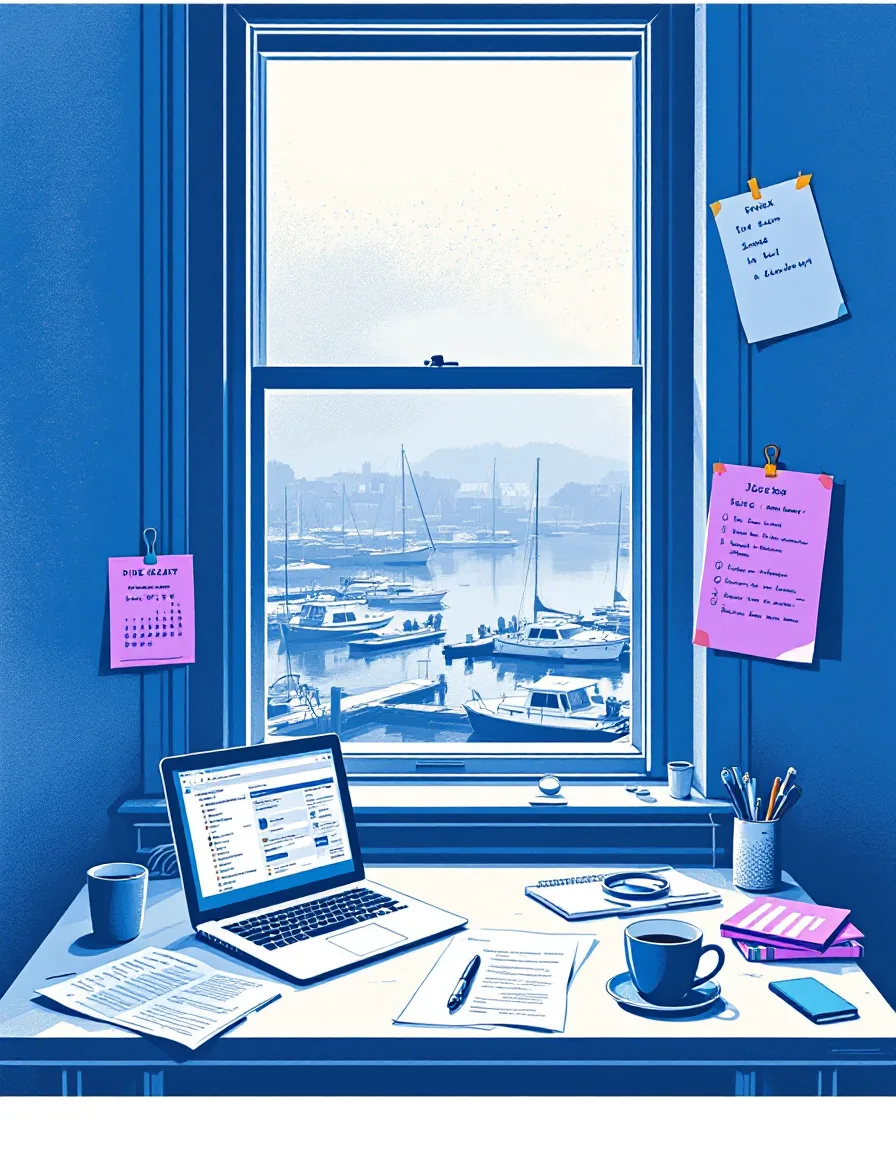
Riso-print illustration of a desk by a window over Gloucester’s inner harbor: laptop inbox, taped-up tide chart, circled calendar date and coffee, with fog lifting off moored lobster boats.
The desk
984 Washington St, Gloucester
Open
weekdays 8am–4:30pm
Embargo mornings
on the desk from 5:30 a.m.
Billing
per launch or per sprint · see prices

On the name

two words on the door, two halves of the job

the patient half

Ferns were around long before flowers, growing slowly in the shade without asking for attention. That’s the unglamorous six weeks before your launch: reading a reporter’s last few months of bylines, checking your MWh against your engineer’s spreadsheet, rewriting the first paragraph until it stops sounding like a grant application.

the loud half, on a schedule

A foghorn doesn’t blast harder when the weather thickens. It sounds at the same interval, every time, and boats steer by it. That’s launch morning: the embargo lifts at 6:00, reporter follow-ups get answered inside the hour, and nobody on your list gets eleven nudges from us in a week.

Here’s the pattern that got us going. A founder has a genuinely new thing — a sorbent, a grid controller, a cheaper way to make cement — and a deck written for investors. The deck lands in a reporter’s inbox and dies on slide three. Meanwhile a company with flimsier tech and a crisper sentence gets the feature.

That gap isn’t about hype. Reporters on the climate and energy beats are sharp, overloaded and allergic to vagueness. They need to know what’s new, why it matters this year, and who outside your company can vouch for the numbers — fast. Most founders know all of that already. It just isn’t written down in reporter English yet.

why a harbor town

Gloucester has been reading weather, tides and fish prices for four centuries. Nobody here treats climate as a panel topic; it’s the forecast, the heating bill, the water at the end of the street. Working a few blocks from the harbor keeps the stories pinned to what changes for actual people — which, conveniently, is what editors keep asking for.

We keep the roster short on purpose, so every launch gets a writer who can explain your chemistry back to you before pitching it to anyone else.

the deck is for investors. the pitch is for one person on deadline. they are never the same document.

Rule zero · written on the whiteboard

what we’re still nerdy about

Interconnection queues. Offtake agreements. Why a pilot running outdoors in a Minnesota February tells a reporter more than a lab run in June. If you can draw it on a whiteboard, we want to understand it well enough to say it in two sentences — and know which reporter will care about sentence two.

Riso-print panorama of Eastern Point Lighthouse and the Gloucester breakwater at dawn, fog rolling in as a lobster boat heads out, wind turbines faint on the horizon.

Eastern Point · 6:00 a.m.

The rhythm we run launch mornings on

The breakwater light keeps one rhythm in every kind of weather. Launch mornings run the same way here — calm, on time, and audible to exactly the people who need to hear it.

The translation desk

what your deck says vs. what we’d actually pitch

This rewrite happens on every kit. The lines below are illustrative, not lifted from any client — but you’ll probably recognise slide three.

Examples of investor-deck language, how a reporter reads it, and the pitch line Fern & Foghorn would write instead
The deck says The reporter hears We’d pitch
“Proprietary sorbent achieving best-in-segment CO₂ uptake at ambient conditions.” numbers i can’t check before lunch A material that pulls carbon out of ordinary air — no furnace, no giant fans — and the raw data’s ready for your outside scientist to poke at.
“Vertically integrated, AI-enabled platform for building decarbonization.” another platform Software that tells a Somerville triple-decker owner which heat pump fits and what it costs after the rebate — in about four minutes.
“We’re on a mission to accelerate the energy transition.” so is everyone Their first utility customer signs the week the embargo lifts. Here’s why that utility said yes.
“TRL 7. Pre-commercial pilot complete.” is it real yet? It’s been running outside the lab, in actual weather — and the founders will tell you what broke.
“Series A led by a leading climate fund.” money moved Here’s what the money builds first, and where — and the town that gets the factory.

Want to see your own slide three get this treatment? It’s the first thing we do in a press kit.

House rules

six things this desk won’t budge on

  1. no.01

    named reporters only

    Every pitch goes to a specific journalist on your beat. If we can’t say who would care and why, the email doesn’t get sent.

  2. no.02

    “not news” gets said out loud

    If the announcement is basically “we exist,” you’ll hear it from us on the first call — not from a reporter, by silence, three weeks later.

  3. no.03

    your numbers stay your numbers

    We don’t round up an efficiency figure or stretch a pilot into a deployment. Every stat in the kit traces to a source your engineers sign off on.

  4. no.04

    embargoes are sacred

    We only brief reporters who honor them, and you always know exactly who has the story, under what terms, and when it can run.

  5. no.05

    corrections before coffee

    If a figure prints wrong on launch morning, the fix request is in the editor’s inbox before 9 a.m. Eastern.

  6. no.06

    coverage is never promised

    Journalists choose what runs. What you get is the kit, the list, the timing and the follow-through — all of it laid out in the Friday debrief.

Fit check

a good match, honestly sized

Saves us both a kickoff call. If you land mostly on the left, we should talk this week.

we’re your desk if…

  • You’re pre-seed to Series B with a dated milestone: a pilot result, a first customer, a raise or a deployment.
  • Your founders will take a short prep call before every interview, even the friendly ones.
  • You’d rather land three right stories than thirty pickups of a wire release nobody read.
  • Your numbers have a source, and your engineers will stand behind them on the record.

call someone else if…

  • You need a guaranteed hit count by a date. Reporters decide what runs; we won’t pretend otherwise.
  • The goal is a lifestyle-magazine splash. Our lists live on the energy, climate and business desks.
  • You want a standing monthly fee that runs whether there’s news or not. We bill per launch or per sprint.
  • The news is that you exist. Come back with a milestone — we’ll happily pick up the phone.

Ready when the date is

got a ship date in pencil? that’s plenty to start counting backwards.

Kickoff calls happen weekdays, 8am–4:30pm. Bring the date, the number you’re proudest of, and one founder who can explain it at a whiteboard.

Press kits $2,850 · outreach sprints $4,650/mo · full launches $11,900 · what’s in each

map my launch call